
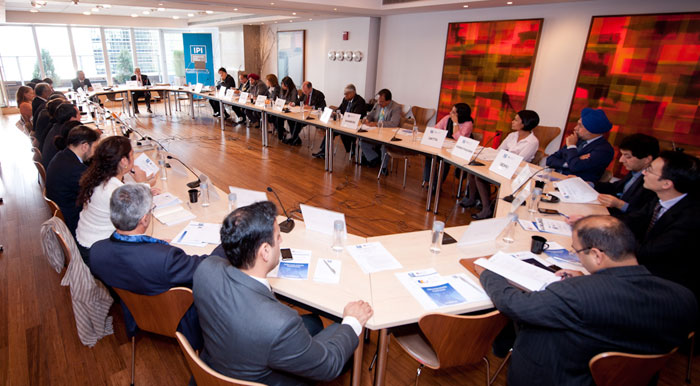
Civil society faces a number of challenges in supporting counterterrorism efforts in South Asia despite an agreement among member states that it plays an important role. These challenges were identified, along with ways to strengthen civil society in preventing and combating terrorism in the region, during a two-day workshop held on October 17-18th at IPI on “Strengthening Regional Security Cooperation and Capacity in South Asia: What Role for Civil Society in Countering Terrorism?” The event was held in partnership with the Center on Global Counterterrorism Cooperation.
Participants of the workshop represented a range of civil society actors, including human rights advocates, media freedom experts, development practitioners, academics, former security and law enforcement, policy analysts, and UN staff. The majority of the participants came from South Asia, along with other international and US-based participants who focus on South Asia in their work.
The participants’ range of backgrounds is reflective of the UN Global Counter-Terrorism Strategy, passed unanimously in 2006 by member states, which calls for a more comprehensive view of counterterrorism, including addressing the “conditions conducive to terrorism” in addition to the more traditional security responses. The diversity of views represented at the workshop offered a unique opportunity to look at counterradicalization and counterterrorism in the region through a variety of different lenses.
The sessions of the workshop, held under the Chatham House rule of non-attribution, examined the four pillars of the UN Global Counter-Terrorism Strategy and its Plan of Action, which calls for measures to: address the conditions conducive to terrorism; prevent and combat terrorism; strengthen states’ capacity to prevent and combat terrorism; and ensure respect for human rights and the rule of law as the fundamental basis of the fight against terrorism.
Other sessions addressed the key regional challenges to multilateral engagement in South Asia, and the role of civil society in countering the terrorist narrative. Participants viewed two documentaries produced by civil society organizations that aim to combat extremist views by putting a human face to terrorism and its victims.
The workshop concluded with a discussion of ways to strengthen the role of civil society in counterterrorism in the region. Participants noted the need for states to improve their relationship with civil society rather than viewing it as a threat. However, they stressed that civil society organizations must be independent from the government in order to be effective and remain credible, especially where governments are not transparent and are violating the rights of their citizens.
Participants pointed out that in some fields, such as development, human rights, and education reform, labeling their work as counterterrorism can be counterproductive, since counterterrorism is often viewed as the hard security response from states and can come with negative connotations. Further, it was noted that civil society is a broad term and is not monolithic; civil society represents a range of views, interests, and goals. In some cases, civil society might actually be involved in supporting terrorist networks and promoting extremist views.
Moving forward, participants suggested that the UN, with its universal membership and international legitimacy, has an important role to play in clarifying the key issues of the UN Global Counter-Terrorism Strategy and bringing together the most effective civil society organizations working on these issues in South Asia to network and strengthen their capacities. It was also noted that the UN could expand its efforts to facilitate engagement between states and civil society in the region in order to build trust and confidence among them.
 Read meeting summary
Listen to Global Observatory interview with Ali Dayan Hasan >>
>>

 777 United Nations Plaza, New York