
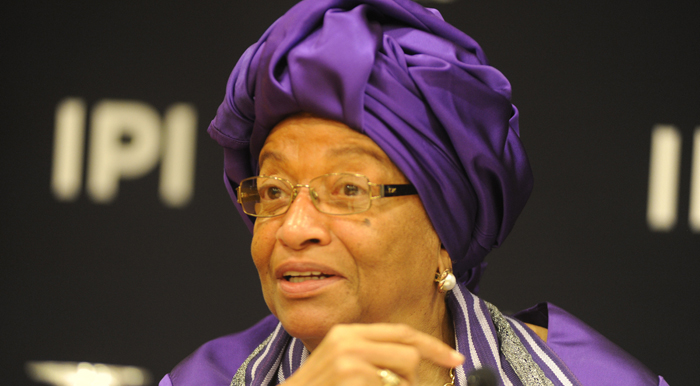
Appearing at IPI on September 26, 2012, Liberian President Ellen Johnson Sirleaf shared an anecdote about the effects female leaders have had on youth in her country. “They were going around [in schoolrooms] and asking, ‘What do you want to be?’ and this little boy said, ‘I want to be Vice President.’ The teacher said, ‘Vice President? Why don’t you aspire to the highest of President?’ The little boy said, ‘You want my friends to laugh at me? President… that’s women’s work!’”
The IPI event entitled “Consolidating a Future in Peace” was part of IPI’s African Leaders Series, a project of IPI’s Africa Program. Former guests of the series include President Abdoulaye Wade of the Republic of Senegal, President Paul Kagame of the Republic of Rwanda, and President Omar Bongo of Gabon.
“I’d like to talk about the role of women in peacemaking and peacekeeping, and the invaluable contributions they have made as meaningful actors in the peace processes of our region,” said President Johnson Sirleaf.
“When the civil war erupted in Liberia in 1990, Liberian women initially concerned themselves with relief efforts, identifying with displaced people in centers across the country. In 1994, when all semblance of civility disappeared, killings intensified, and women became the victims.”
She continued, “In February, 1994, a Liberian women’s initiative called a mass meeting of women, with the only criteria for joining being a commitment to peace and the unity of our country. Women turned out in the thousands. Thereafter, they staged peaceful demonstrations admonishing the warlords that they wanted peace, not war; that if anybody wanted to rule a country, they should go to the ballot box and not resort to a gun.”
The movement of which President Johnson Sirleaf spoke of was led by peace activist Leymah Gbowee and known as “Women of Liberia Mass Action for Peace.” The movement helped bring an end to the Second Liberian Civil War, which killed nearly 150,000 people. Its work was featured in a 2008 award winning documentary Pray the Devil Back to Hell. In 2011, President Johnson Sirleaf and Leymah Gbowee were awarded the Nobel Peace Prize, which they accepted on behalf of the Liberian people.
“Women continue to be those peacebuilders, continue to promote the environment that enables all citizens to search for peace, to maintain peace, and to use the security that peace brings to be able to join the processes of development that will touch lives and change the conditions of human kind,” she said.
On international aid organizations, President Johnson Sirleaf emphasized the need for outside actors to work closely with the beneficiaries. She said, “Aid has not been as effective as it should have been because we have not grounded it in what the people want.”
President Johnson Sirleaf also engaged in discussion with the audience about religious rights and the role of religion in society. “There will always be people of different faiths, in our country and countries across the world… All societies must ensure that there is no discrimination and that there’s equal access to justice, to opportunity, to equity for all regardless of those differences.”
She added, “As you look across the Muslim world today, you can already see changes taking place in all of those strongly traditional societies. Women are taking positions, women are more open, women are challenging those things.”
Asked by an audience member about her legacy, President Johnson paused first to consider her response. Then she said, “I already told you what the little boy said.”
The event was moderated by Terje Rød-Larsen, President of the International Peace Institute.
Press Coverage
Liberia: Ellen Discusses Liberian Women’s Involvement in Peacemaking
Watch event:

 777 United Nations Plaza, New York