
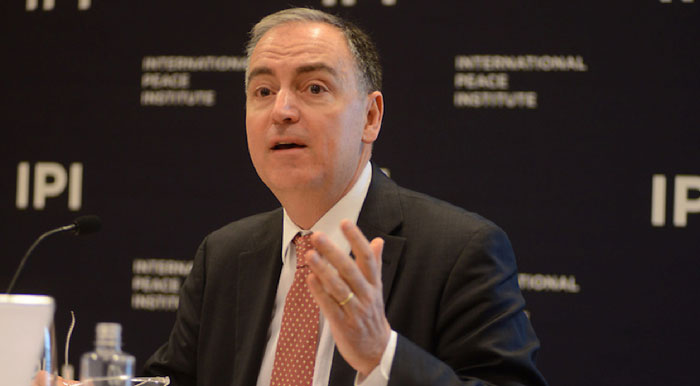
“We really consider the Syrian humanitarian situation as one of the most complex and dangerous operations in the world as of 2013,” said Panos Moumtzis, UNHCR Regional Refugee Coordinator for Syrian Refugees, at IPI’s Humanitarian Affairs Series event on the Syrian refugee crisis, held on January 17, 2013.
“It’s complex because it involves five, six countries, [and] very dangerous because the fear and risks of regional expansion of the conflict is very real and very high,” he added.
Mr. Moumtzis coordinates the agency’s approach to the unfolding crisis in Syria and the neighboring countries of Lebanon, Jordan, Turkey, and Iraq. He discussed the current and future challenges facing humanitarian actors and governments alike in coordinating and delivering aid to the refugees scattered across the region.
“We have registered in the neighboring countries a total of 642,000 refugees, and this includes the refugees that have crossed into Jordan, Lebanon, Iraq, Turkey and Egypt [and] also refugees who cross into North Africa with a continuous flow also going into European countries,” he said.
UNHCR already anticipates assisting up to 1.1 million refugees between now and the end of June, bringing the total to 5 million Syrians, or a quarter of the population, in need of assistance.
Discussing the recent UN appeal for $1.5 billion, its largest ever, Mr. Moumtzis explained that $500 million is to cover the humanitarian needs inside Syria and $1 billion to cover the needs of the regional refugees.
“The number one concern we have for inside Syria is the protection of civilians,” he explained.
Having worked on several humanitarian crisis for two decades, Mr. Moumtzis noted that what really struck him in his work on the Syrian situation was the unprecedented surge of humanitarian assistance. All the agencies, including nongovernmental organizations, had to increase their capacity to be able to respond 24/7 to the crisis, as refugees pour into the borders day and night.
“The refugees who flee at the moment, seventy-five percent of them are women and children. Actually more than half of them are children. This is a children’s refugee crisis,” he remarked. Observing the situation first-hand, Mr. Moumtzis explained that many of the children are withdrawn, having experienced some of the most horrific scenes imaginable. In order to restore some sense of normalcy, some of the programs led by agencies such as UNICEF that provide psycho-social support, he said.
Mr. Moumtzis went on to say, “In our planning and response for 2013 we have given a priority in particular to refugees who are also outside camps. Thirty percent of the refugees are in camps, seventy percent are in outside camps, in villages, towns, and other locations.”
Due to the extreme harsh weather in the region, the situation has been particularly challenging over the past few weeks. As Mr. Moumtzis pointed out, Jordan received an equivalent of two thirds of its annual rainfall during the course of seven days. In Jordan’s Zataari camp, flooding and high winds caused over 100 families to lose their tents.
“Clearly, the humanitarian response that we are providing is not the solution. What is really needed for this crisis is a political solution. Unfortunately, at the moment, we haven’t seen any,” he said.
Mr. Moumtzis also mentioned how much the agency appreciates that the borders in the region remain open, enabling the civilians fleeing the conflict to cross the border safety.
“It is extremely important that the international community show its solidarity and support to the neighboring countries,” he added, expressing that the international support is crucial in maintaining the open border policy.
In ensuring the civilian character of the refugee camps, Mr. Moumtzis said, “If somebody has arms, that person is not a refugee, period. We will not tolerate, we will not accept, we will not recognize any military activity in a camp or outside camp. We’re working with taxpayer’s money. We’re really guided by humanitarian principles.”
When the refugees first arrive, they go through a basic but important registration interview process. When soldiers come forward, they go through a demobilization process in separate camps.
Responding to questions regarding the political side of the crisis, Mr. Moumtzis expressed that as humanitarian actors, they feel a high level of frustration. They shared their observations with host-states and governments, but despite efforts to reach out, the international community has not been able to find a viable solution.
“We feel like we have to bear the consequences of a lack of political will or agreement or consensus to move to a solution,” he added.
Highlighting the challenges of the Syrian refugee crisis, Mr. Moumtzis mentioned that humanitarian actors feel like they have to catch up in handling the amount of Syrian refugees coming in. But while they provide a short-term response for the refugees, the agencies hold onto the hopes of stability in the country for the refugees’ return.
The event was chaired by Jérémie Labbé, IPI Senior Policy Analyst.
Interview with Panos Moumtzis, UNHCR Regional Coordinator for Syrian Refugees
Watch event:

 777 United Nations Plaza, New York