 Private military and security companies play an increasingly visible role in conflict and post-conflict situations. Properly regulated, they may offer efficient and responsive means for governments to deliver security in insecure environments. But well publicized abuses suggest that an adequate regulatory framework is urgently needed.
Over the last three years, IPI has played a key role in international efforts to develop innovative regulatory responses to the rise of the private security industry. IPI worked closely with seventeen states that developed and drafted the Montreux Document, which was concluded in September 2008.
At the urging of some of the governments and industry actors engaged in the Montreux Process, IPI undertook a large, highly-consultative research project in 2008-2009 to examine models of state and market-based regulation in thirty global industries in order to assess their relevance for the global security industry.
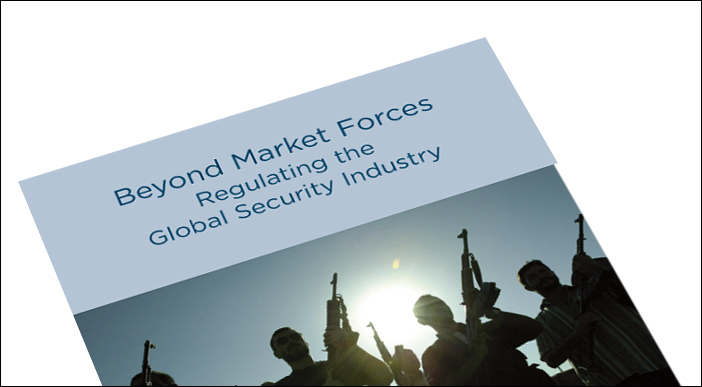
The results of this study are now available in Beyond Market Forces: Regulating the Global Security Industry, a new book authored by an IPI research team led by James Cockayne.
Beyond Market Forces surveys the existing state of national, international, and corporate-level regulation of this industry, including more than forty Codes of Conduct. It provides thirty case studies looking at frameworks for implementing and enforcing industry standards in other global industries such as the extractive, textile and apparel, toy, toxic waste, financial, sporting, chemical, and even veterinary industries. And it draws lessons from these industries specifically for the global security industry, identifying five different types of implementation and enforcement framework that the industry could consider: a watchdog, an accreditation scheme, an arbitral tribunal, a harmonization scheme, and a club.
Also available for download are a 3-page policy brief containing the key policy recommendations, and a 20-page policy report exploring these recommendations at more length.
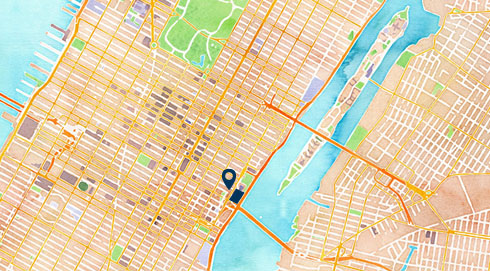
 777 United Nations Plaza, New York