
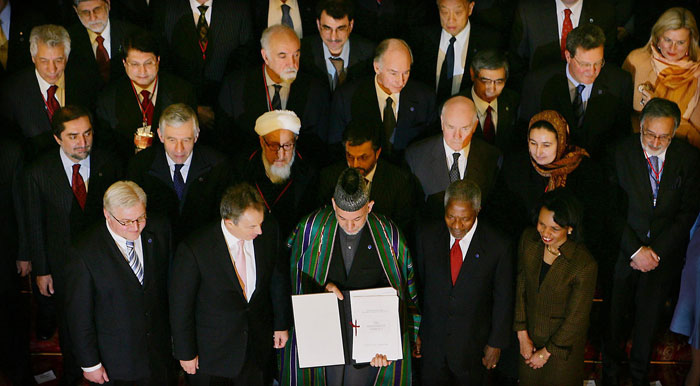
 The policy report draws lessons-learned for the UN and others from the first generation of transition compacts in support of postconflict peacebuilding, focusing on case studies from Afghanistan, the DRC, Iraq, Liberia, and Timor-Leste.
It finds that transition compacts can be effective but their effectiveness has been mixed. In order to improve their effectiveness the report makes the following recommendations among others:
• Compacts should be considered only when a peace accord is agreed upon and where basic security is in place.
• Civil society should be given the opportunity to participate in both compact creation and implementation.
• Compact commitments should be specific, balanced, and focused on short timelines.
• Compacts should reinforce and coordinate with ongoing international and national processes.
• Compacts should include specific mechanisms for implementation, oversight, and enforcement, with host governments in the lead.
The report also recommends that the UN among other things should:
• continue to support transition compacts and should continue to work with the OECD-DAC INCAF to support the provisions in its guidance on transition financing;
• improve its technical support for compact development, implementation, and capacity building;
• improve mechanisms for ensuring the timeliness and flexibility of transition support by donors, including through global and country-level pooled funds; and
• work with host governments to strengthen capacity building and work with donors and IFIs to improve donor coordination.
The report is the result of a collaborative effort between IPI and the UN, with substantive input from the OECD-DAC Secretariat of the International Network on Conflict and Fragility (INCAF).
A seminar called “Transition Compacts: Lessons from UN Experiences” was hosted by IPI in November 2011, and the resulting meeting note can be found here.

 777 United Nations Plaza, New York