
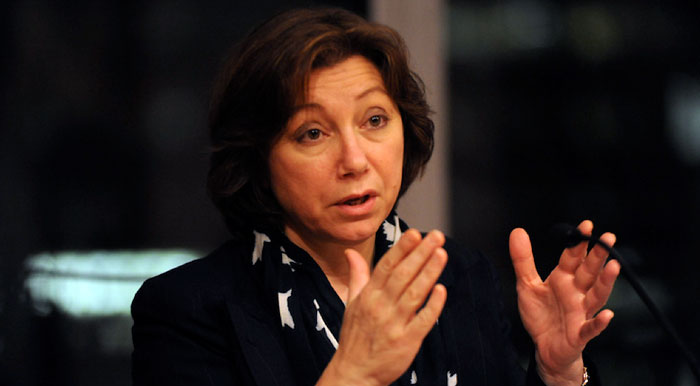
The way out of the Syrian quagmire is through a unified, representative political authority that is responsible for channeling support to armed opposition groups and providing services to the Syrian people, Dr. Bassma Kodmani, Syrian academic and former spokesperson for the Syrian National Council, told an IPI audience on October 11th.
Speaking at an event in IPI’s Arab Intellectuals Series, Dr. Kodmani offered insights into the current situation in Syria and made the following points in outlining how Syrian and international actors could bring the country out of its ravaged condition:
1. The Free Syrian Army, made up of opposition groups from all segments of society, has mostly found support from Islamist sources. Groups that identify with liberal ideals have not found anyone to turn to for armaments and financing.
2. To address this imbalance and unite the opposition, representatives from all sectors of Syrian society need to form an umbrella political authority that is entrusted with responsibility for channeling financial support and armaments as well as providing services to the Syrian people.
3. By working with local groups already providing a range of social and security services on the ground and ensuring the full participation of members of all political affiliations, such an authority would have the legitimacy required to lead both before and after the fall of the regime, until a transitional phase begins. It is particularly important to include those who have defected from the regime and members of the Ba’ath party.
4. International actors should announce their readiness to recognize such a political authority as soon as it is created, granting it legal recognition later. To ensure it can provide services and a centralized source of support—the main sources of its legitimacy—the international community must also ensure this umbrella body has the means to do so.
5. The international community needs to start preparing for the aftermath of the Syrian conflict. In this context, the UN–Arab League special envoy Lakhdar Brahimi can play a valuable role by exploring ways to reach an orderly transfer of power. And while an International Criminal Court indictment of Bashar al-Assad would not make the regime more or less likely to negotiate today, it will be needed for justice and reconciliation.
6. Any call for Kurdish separation from Syria could trigger a similar call from the Alawite community. An agreement that is Syrian, regional, and international in form should provide guarantees to the Kurdish community, with a view to opening the discussion again with an elected body at a later date.
Dr. Kodmani concluded by emphasizing the need for new creative thinking and instant action to avoid a “drift scenario” in Syria.
The event was moderated by Abdullah Alsaidi, IPI Senior Adviser.
 Download this text as a meeting brief
Watch event:

 777 United Nations Plaza, New York