
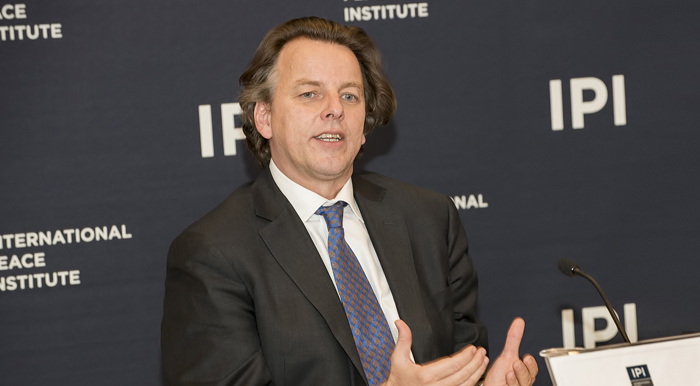
“It’s very clear that Côte d’Ivoire can do two things: export its stability in the region or import the instability, and therefore for us, the developments in the region are quite crucial,” said Albert Gerard (Bert) Koenders, Special Representative of the Secretary-General and Head of the United Nations Operation in Côte d’Ivoire (UNOCI), at an IPI SRSG Series event held on January 18, 2013.
Mr. Koenders spoke at IPI after having briefed the UN Security Council on the status of UNOCI, including its reconciliation efforts in the country.
Once West Africa’s most prosperous society, Côte d’Ivoire was hit with a civil war a decade ago that divided the country North and South. In 2010, post-electoral violence left 3000 people killed and forced some 700,000 to flee their homes.
“It tore, in my view, the fabric of the country further apart, a country that had already experienced a decade of recurrent crisis,” he said.
Referring to the current crisis in Mali and West Africa, Mr. Koenders believed it was important to discuss Côte d’Ivoire as well because “it reinforces the need for Côte d’Ivoire to go as fast as possible in a direction of peace and stability.”
Côte d’Ivoire’s GDP equates to 40% of the region’s and 55% of the industrial production of Western Africa, which is slowly getting back to business after long years of decay.
Building on the lessons from the 2010-2011 conflict, Mr. Koenders believed that peacekeeping should involve planning ahead for post-electoral violence. He said that elections should be “a part of a system of the creation of reconciliation, of rule of law, of political party support and so on.”
“We are on a period of optimism, in my view, of Africa and the situation in Côte d’Ivoire. If you look at the beginning of the cycle of violence in Côte d’Ivoire, it was a combination, I think, in the beginning of the 90s, of a very quick democratization – the end of the one party state. The democratization took place in a period of very quick deterioration of the cocoa prices, of the economy, of a high degree of international migration into the country and the beginning of what became the politicization of the ethnicity of the country,” Mr. Koenders said.
Currently in Côte d’Ivoire, there are some initiatives taken by the government to discuss with the opposition the possibility of having inclusive local elections.
In dealing with the country’s national reconstruction and reconciliation efforts, Mr. Koenders detailed three important factors to consider.
The first one was security. With over 9,000 military personnel and 1,000 police members, Mr. Koenders believed that human development can only work if there is security, specifically with the protection of civilians. Security is also crucial for the economic development of the country.
The second is the security sector reform (SSR) and demobilization, disarmament, and reintegration (DDR). The challenges there, as Mr. Koenders pointed out, were building confidence between the different units of security personnel and between the citizens.
“Everyone knows that DDR is not just a technical issue, it’s a very highly political issue. How do you ensure that people are demobilized, that it happens in a political balanced way, that it is transparent and first and foremost that there is a relationship between disarmament and the reassertion and reintegration. We are making progress on that but it remains a major challenge,” he conveyed.
For the country, 2012 was a difficult year. Although there was progress in human security and development, it still saw attacks and radicalization of parts of the opposition and vulnerability of security sector.
“Peacekeepers are not there to stay forever. Like a dinner party, they could go too early or too late. Finding the right time of leaving is not always easy; we have to be very vigilant,” he said.
Mr. Koenders highlighted some of the important issues in peacekeeping missions that need to be prioritized, including issues of security, political dialogue, reconciliation and economic development.
There has been progress in political dialogue, national reconciliation, justice and human rights, Mr. Koenders noted. He said that the key is having the Ivorian stamp, but the struggle is how to best go about it.
Other areas of state building the government and the UN Mission are working on include ensuring that equitable justice is being implemented, strengthening the country’s human rights capacity, working on conflict prevention, training programs for the army, and land law reform.
“We have chosen with the government but also with the civil society and all the partners where we can make a difference, and the difference can only be catalytic,” Mr. Koenders pointed out.
Finally, the third priority is to give a boost to economic development in the country, on the basis of the national development plan.
Mr. Koenders indicated that the work of the mission will need to go from substitution to support, stressing the importance of bringing forward the nexus of SSR, DDR, dialogue and reconciliation.
The event was chaired by Warren Hoge, IPI Senior Advisor for External Relations.
Interview with Bert Koenders, SRSG for Côte d’Ivoire and Head of UNOCI
Watch event:

 777 United Nations Plaza, New York