
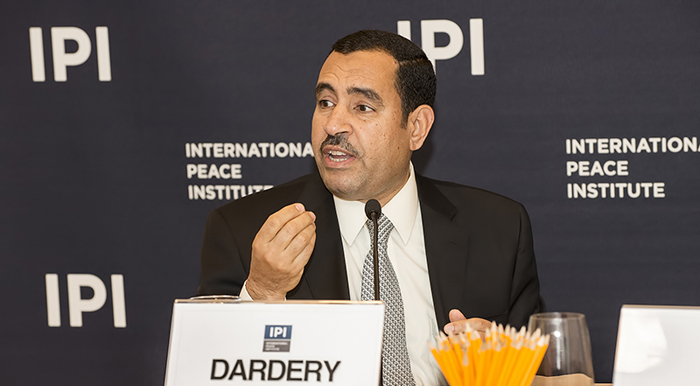
Dr. Abdul Mawgoud Dardery, an Egyptian parliamentarian who is a spokesperson for the Muslim Brotherhood’s Freedom and Justice party, told an IPI audience that dialogue and a willingness to reach agreement with political rivals were integral parts of the organization.
Addressing portrayals of the Muslim Brotherhood as a radical group that sought to dominate Egypt, he pointed out that less than 10 percent of the 35 ministers in the government are from the party and stated:
“We believe that Egypt is bigger than the Muslim Brotherhood, it’s bigger than the Freedom and Justice Party. Egypt is for all the Egyptians and all Egyptians are really required to come together, work together so that they can produce the best alternative that Egypt deserves.”
Conceding that many people still protested what they thought was the party’s majoritarian instinct, he said that high expectations for change are not realistic. “We still need to put the laws into perspective so that everyone feels that he or she is under the law,” he said.
Dr. Dardery appeared at IPI on February 4, 2013 at an event entitled “Reflections on Egypt’s Revolution: Two Years Later.” He is currently the director of the Luxor Islamic Center for Global Dialogue and served as the Muslim Brotherhood’s Freedom and Justice party (FJP) Member of Parliament for Luxor in 2011 and 2012. As a member and spokesperson of the Foreign Relations Committee of the FJP, he headed his party’s first delegation to the White House in April, 2012.
Though Egypt’s transition thus far has witnessed a number of gains made in procedural democracy, little progress has been made in the domains of institutional reform and public policy. As the country prepares for a crucial upcoming parliamentary election in a few months time, Dr. Dardery discussed several important issues that Egypt still needs to address as it continues its transition from decades of authoritarian rule.
Dr. Dardery said the turmoil and political skirmishes that followed the 2011 uprising, which he characterized as a peaceful revolution, was a natural development that was to be expected.
Following the uprising, a constitutional referendum was held on March 2011 that approved several constitutional reforms in the areas of the presidency, elections and the drafting of a new constitution following the parliamentary elections.
“The Egyptian people in the March referendum chose to go the legal, gradual way, not the revolutionary way, and that meant a lot,” said Dr. Dardery.
But while progress has been made, Dr. Dardery acknowledged that the state structure has not been transformed yet, making it difficult for the people to feel the change. He highlighted four areas in the state where corruption still exists: the police, judiciary, the state bureaucracy and the media.
Dr. Dardery asserted that these were major challenges that are likely to take some time to overcome.
In the question and answer period, he was asked why he didn’t include the military, which has considerable political and economic influence. Dr. Dardery responded that although it was part of a corrupt regime and was influenced by the corruption, specifically within its economic dimensions, a unique characteristic of the Egyptian military is that it is devoted to the national interest of the country.
The National Salvation Front (NSF) is an alliance of political parties opposed to current President Mohamed Morsi’s constitutional declarations. But as Egypt becomes increasingly polarized, efforts for a national consensus have failed, which Dr. Dardery blames on the NSF.
He claimed that the NSF was providing a “political clout” for the violent clashes taking place. “For politics, we need to be able to dialogue things rather than to violently oppose one another,” he said.
Since President Hosni Mubarak’s time, the young people of Egypt have said they feel alienated from the political process. Dr. Dardery said that the involvement of the youth in leadership positions is really moving in the right direction.
“There’s no doubt the youth were the ones who led the revolution in the streets of Egypt,” he asserted. However, he said it will still take some time until the youth feel a stronger sense of belonging and start to participate politically to a larger extent.
In addition to youth disillusionment, two major issues Egypt continues to struggle with are the economy and security reform. Tourism, which is Luxor’s major source of income, was impacted severely during the turmoil, although it has slowly been building back up.
Overall, he said, the big obstacle to state reform is the need to amend the legal system. Many Egyptians do not trust the legal system because it has always been referred to as “their system” and not “our system,” Dr. Dardery argued.
Dr. Dardery said that President Morsi was trying to develop a paradigm of diplomacy based on mutual understanding and mutual respect. To that end, he said the government of Egypt is committed to working with other countries on the basis of the two ideals.
The event was moderated by Nur Laiq, IPI Senior Policy Analyst.
Interview with Abdul Mawgoud Dardery, Egyptian Parliamentarian
Watch event:

 777 United Nations Plaza, New York