
Skip to content

International Peace Institute

  • Our work
    • Revitalizing Multilateral Cooperation
    • Peace Operations and Peacebuilding
    • Women‚ Peace and Security
    • Peace‚ Climate‚ and Sustainable Development
    • IPI en français
  • Events
  • Publications
  • About

    The International Peace Institute is an independent, non-profit organization working to strengthen inclusive multilateralism for a more peaceful and sustainable planet. Through its research, convening, and strategic advising, IPI provides innovative recommendations for the United Nations System, member states, regional organizations, civil society, and the private sector. With staff from around the world and a broad range of academic fields, IPI has offices facing United Nations headquarters in New York.

    About IPI

    • Job Openings & Internships
    • Our Mission
    • Board & Council
    • Contact
    • Team
    • News

    Support IPI

    • Ways to Give
    • Annual Report & Financials
  • Donate
  • Follow Us
    • Subscribe to our communications
    • Bluesky Join us on Bluesky
    • Facebook Like us on Facebook
    • LinkedIn Connect on LinkedIn
    • Instagram Follow us on Instagram
    • Youtube YouTube
Donate

Author Simon Chesterman

Simon Chesterman

Read more articles →

  • Books 07-15-2005by Simon Chesterman

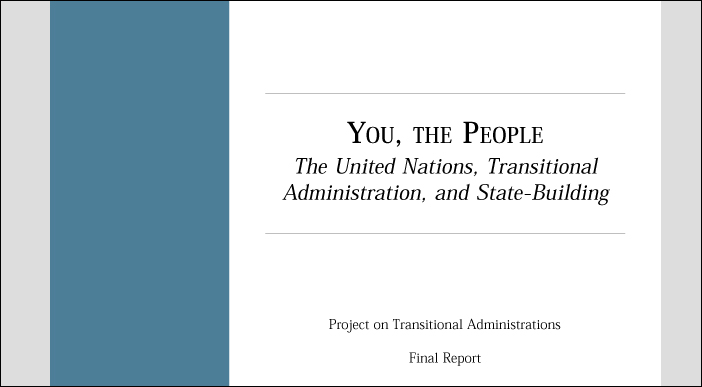
    You, the People: The United Nations, Transitional Administration, and State-Building

    The governance of post-conflict territories embodies a central contradiction: how does one help a population prepare for democratic governance and the rule of law by imposing a form of benevolent autocracy?Aimed at policy-makers, diplomats, and a wide academic audience (including international relations, political science, international law, and war studies), the book provides a concise history […]

    Read more
    Multilateral System, Peace and Justice
  • Policy Papers 07-15-2004by Simon Chesterman, Michael Ignatieff and Ramesh Thakur

    Making States Work: From State Failure to State-Building

    It is frequently assumed that the collapse of state structures, whether through defeat by an external power or as a result of internal chaos, leads to a vacuum of political power. This is rarely the case.

    Read more
    State Fragility
  • Policy Papers 11-15-2003by Simon Chesterman

    You, the People: The United Nations, Transitional Administration, and Statebuilding

    This, the final report of the Transitional Administrations project, surveys the brief history of UN transitional administration, before elaborating on three contradictions that have emerged in the conduct of such operations.

    Read more
    Multilateral System
  • Meeting Notes 01-15-2003by Simon Chesterman

    You, the People: Transitional Administration, Statebuilding and the United Nations

    Report summarizing the discussions and recommendations at an IPA [now IPI] conference on UN Transitional Administrations (New York, October 18-19, 2002).Download

    Read more
    Multilateral System
  • Policy Papers 09-15-2002by Simon Chesterman

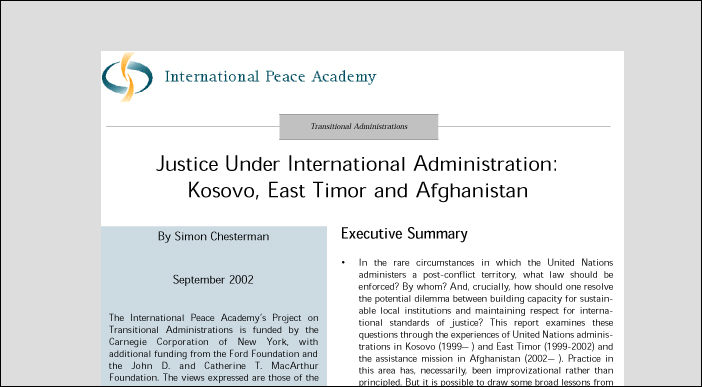
    Justice Under International Administration: Kosovo, East Timor and Afghanistan

    This report emerged from the Transitional Administrations Project, comparing the UN’s judicial reconstruction efforts in Kosovo, East Timor, and Afghanistan.

    Read more
    Peace and Justice
  • Policy Papers 09-15-2002by Simon Chesterman

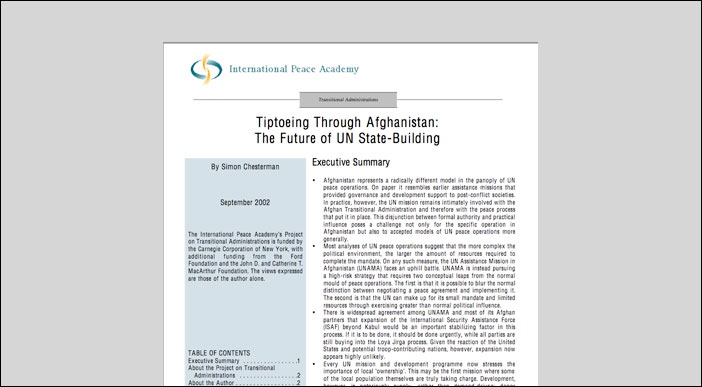
    Tiptoeing Through Afghanistan: The Future of UN Statebuilding, Simon Chesterman

    A report from the Transitional Administrations Project, examining UNAMA’s involvement in statebuilding activities in Afghanistan.

    Read more
    Peacebuilding
  • Meeting Notes 07-14-2002by Simon Chesterman, rapporteur

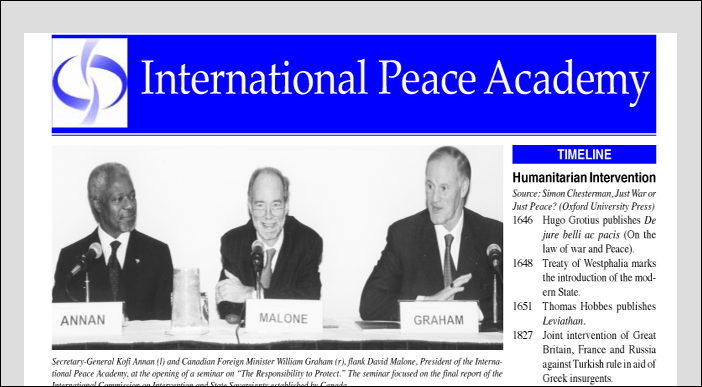
    Discussions at the Release of the Responsibility to Protect

    A synopsis of the panel discussions at the February 15, 2002, release of the Report of the International Commission on Intervention and State Sovereignty (ICISS), entitled The Responsibility to Protect.Download

    Read more
    Responsibility to Protect
  • Meeting Notes 07-13-2002by Simon Chesterman

    2002 Vienna Seminar: Central Asia’s First Decade of Independence: Promises and Problems

    The seminar examined how successfully the states of Central Asia have managed the challenges of peace and security, economic development, and governance in the first decade of their independence. The seminar also explored the prospect of enhancing cooperation both at the intra- and inter-regional level with the objective of strengthening the institutions entrusted with the […]

    Read more
    Governance
  • Meeting Notes 06-13-2002by Simon Chesterman and Béatrice Pouligny, rapporteurs

    The Politics of Sanctions

    This report draws upon insights shared at two meetings on sanctions convened by the International Peace Academy [now International Peace Institute] in Paris in November 2001 and London in March 2002.

    Read more
    Sanctions
  • Policy Papers 08-15-2001by Simon Chesterman

    Kosovo in Limbo: Statebuilding and “Substantial Autonomy”

    A report from the Transitional Administrations Project, examining statebuilding under the aegis of UNMIK, and considering questions on Kosovo’s autonomy.Download

    Read more
  • Next →

Recent articles from
the Global Observatory

  • The Path to Transitioning away from Fossil Fuels after COP30

    December 5, 2025 by Jimena Leiva Roesch, Jonah Harris

    As negotiators and climate leaders around the world process the outcomes of COP30, there is widespread disappointment that the parties did not agree on a roadmap for transitioning away from fossil fuels (TAFF). This omission reflected the complexity of the…

    Analysis
  • Why African Countries Pay Billions More to Borrow

    November 26, 2025 by Bitania Tadesse, David Mulet

    In February 2025, African heads of state gathered in Addis Ababa to announce a bold challenge to the global financial order: the continent will launch its own credit rating agency. The move follows years of mounting frustration over the…

    Analysis, africa, Africa and the Global Order
  • Getting to a Stronger Security Council Response to the Atrocities in El Fasher

    November 20, 2025 by CJ Pine

    Since the Rapid Support Forces (RSF) captured the city of El Fasher in Sudan’s Darfur region…

    Analysis, africa, human rights, protection of civilians
  • Adapting Peacemaking to Conflict in the Digital Age: Six Priorities for Mediation

    November 18, 2025 by Nicola Williams

    Armed conflict no longer unfolds solely on the battlefield. It is fought fiercely along digital frontlines—from…

    Analysis, cyber security, peacebuilding
  • Getting Stabilization Right in Gaza

    November 10, 2025 by Bert Koenders, Hiba Qasas, Lt. Gen. CJ (Kees) Matthijssen

    President Trump’s 20-point Gaza peace plan and the New York Declaration on a two-state solution have created an opening for peace in Gaza—though one that is fragile and fraught with danger. These blueprints are wide in scope but light on detail where it matters, including on stabilization…

    Analysis, middle east, peacebuilding
  • To Confront Authoritarianism and Militarism, WPS Advocates Must Form a Broader Movement for Peace

    November 6, 2025 by Carly Paul, Marie Berry

    In recent weeks, we’ve witnessed the escalating…

    Analysis, peacebuilding, Women‚ Peace and Security at 25
  • CTED’s Mandate Renewal: A Chance to Assess the Future of Security Council Counterterrorism Efforts

    November 5, 2025 by Naureen Chowdhury Fink

    This December, the mandate of the UN…

    Analysis, security council, terrorism
  • It Is Time for a Disability, Peace, and Security Agenda: Interview with Heba Hagrass

    November 3, 2025 by Albert Trithart

    Around 1.3 billion people experience significant disability—around 16% of the world’s population.…

    Interviews, humanitarian affairs, middle east
  • The Grassroots Origins of Resolution 1325: Interview with Sanam Naraghi Anderlini

    October 31, 2025 by Phoebe Donnelly

    Today marks the 25th anniversary of the passage of Resolution 1325, which launched the women, peace, and security (WPS) agenda. This resolution…

    Interviews, Women‚ Peace and Security at 25
  • It’s Time to Restore the UN’s Political Role in the Israeli–Palestinian Conflict

    October 30, 2025 by Daniel Safran-Hon, Diego Salama

    Never has the cliché that we are at a pivotal moment in Middle East diplomacy been more…

    Analysis, middle east, peacebuilding

IPI 777 United Nations Plaza, New York

Email: [email protected]

Phone number: +1-212-687-4300

United Nations

Follow Us:

Bluesky Facebook Youtube Instagram LinkedIn

Subscribe to our communications:

Subscription page

About the International Peace Institute

The International Peace Institute is an independent, non-profit organization working to strengthen inclusive multilateralism for a more peaceful and sustainable planet. Through its research, convening, and strategic advising, IPI provides innovative recommendations for the United Nations System, member states, regional organizations, civil society, and the private sector. With staff from around the world and a broad range of academic fields, IPI has offices facing United Nations headquarters in New York.

About IPI Global Observatory

The Global Observatory provides timely analysis on trends and issues related to global security.

© 2025 IPI International Peace Institute | Privacy Policy

Subscribe to IPI Newsletter

* indicates required

Subscribe to IPI Events

* indicates required